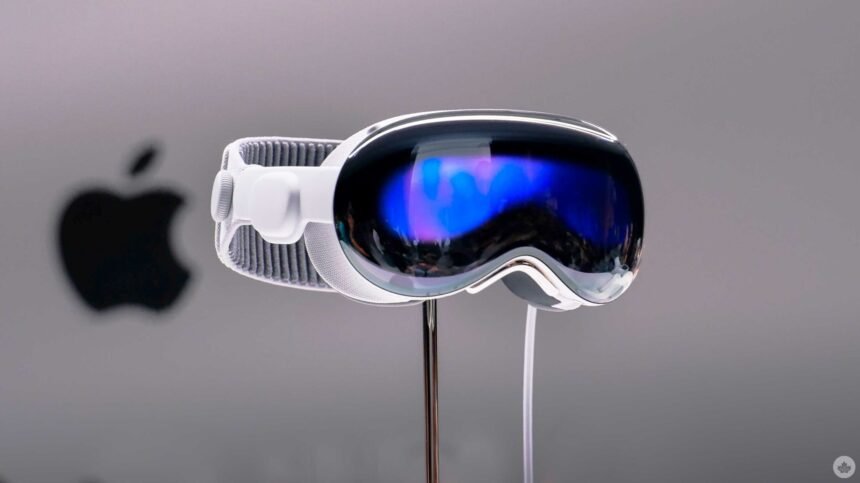
The Apple Vision Pro is one of the boldest consumer tech bets from Apple in years. It positions itself not merely as a VR headset, but as a “spatial computer” that blends augmented reality (AR) and virtual reality (VR) in one wearable. Priced at US $3,499 (≈ ₹2.9 lakh) at launch, it’s a premium device aimed at early adopters, creators, and professionals.
In this in-depth review we’ll explore design & build, display & visuals, performance & hardware, software & ecosystem, use-cases, battery & comfort, and ultimately answer the question: Is AR/VR finally ready for you? We’ll also include one detailed specs table and evaluate pros & cons.
Design & Build Quality
The Vision Pro features a high-end build: a glass front-panel, aluminium frame, and a modular head-strap system. According to Apple’s specs page:
- Weight: around 750–800 grams for the M5 version.
- Dual micro-OLED displays totalling 23 million pixels.
- Support for hand, eye, and voice input; no physical controllers required for basic operation.
Users and reviewers highlight that the fit and comfort are commendable for short-term use, but front-heaviness and the external battery pack remain significant drawbacks:
“For me … the main issue the reviewer has is that it’s front heavy.”
“Battery pack hanging, cable, weight … makes it feel more like a luxury gadget than daily wearable.”
Verdict: Premium materials and finish, but the weight, bulk and tethered battery limit it for extended daily wear.
More Read

Display & Visual Experience
The Vision Pro is exceptional in its display specs. Key highlights:
- Micro-OLED dual displays with 23 million combined pixels.
- Supported refresh rates: 90 Hz, 96 Hz, 100 Hz; the newer M5 version supports up to 120 Hz.
- High color gamut: 92% DCI-P3.
- Foveated rendering and very low photon-to-photon latency via the R1 chip (~12 ms).
In real use:
- Reviewers call it “incredibly sharp, no screen-door effect” and “the best I’ve used for passthrough/AR”.
- Mixed feedback on motion clarity and pass-through darkness in certain lighting conditions.
Verdict: One of the finest display systems in a consumer AR/VR headset. If you prioritize visual fidelity, the Vision Pro delivers.

Performance & Hardware
The hardware inside the Vision Pro is essentially desktop-class, repackaged as AR/VR. According to Apple’s spec sheet:
- M5 chip (10-core CPU + 10-core GPU + 16-core Neural Engine) for the latest model.
- R1 chip dedicated to sensor input and extremely low latency.
- Storage: 256 GB / 512 GB / 1 TB.
- Input modalities: hand tracking, eye tracking, voice; external accessories supported (keyboards, trackpads, controllers).
In practical terms: reviewers found performance very smooth, interfaces fluid, and multitasking of spatial windows possible — something other headsets struggle with.
Verdict: Absolutely top-tier hardware; no compromise on processing power. The capacity is there — but the ecosystem and content are the bottleneck.
Software, Ecosystem & Use Cases
The device runs visionOS, Apple’s new spatial operating system. Key features:
- Apps can be placed in your physical space, resized, rearranged.
- Mac integration: you can use it as a giant external display.
- Spatial video & photo capture.
However, limitations:
- At launch, app ecosystem is thin; many third-party titles and games are lacking.
- Some users find that for productivity tasks after many hours the device still requires a companion Mac or iPad rather than replacing it.
Verdict: The software and ecosystem provide a glimpse into what spatial computing might become. But for most users, it’s not yet a full replacement for other devices.
More Read

Battery Life & Comfort
Battery life for the Vision Pro is modest:
- M5 model: up to ~2.5 hours general use, up to 3 hours video playback.
- External battery pack adds bulk and tethering.
Comfort:
- Head-strap system adjustable and modular.
- However, the weight (~750–800g) and battery strap make extended sessions (3+ hours) less comfortable than light VR headsets. Some users reported fatigue and red-marks after short use.
Verdict: Good for short immersive sessions, but not yet ideal for all-day wear in comfort.
Value & Pricing
The starting price is US $3,499 for the base 256 GB model.
Given its capabilities and premium build, this is high, especially when compared to more affordable VR/AR alternatives.
Value proposition:
- If you’re a creator, developer, early adopter, or deeply embedded in the Apple ecosystem, the value might justify the cost.
- For casual users who want VR/AR for entertainment or some productivity, the price and limitations make it a hard sell.
Key Specifications Snapshot
| Feature | Specification |
|---|---|
| Display | Dual micro-OLED, 23 million pixels total |
| Refresh Rate | Up to 120 Hz (M5 model) |
| Processor | Apple M5 + R1 (M2 + R1 in earlier version) |
| Storage Options | 256 GB / 512 GB / 1 TB |
| Battery Life | ~2.5 hrs general use, ~3 hrs video (M5) |
| Input Methods | Hand, eye, voice, external accessories |
| Price | From US $3,499 |
Pros & Cons
Pros:
- Exceptional visual fidelity, arguably best in class.
- High-end hardware making it future-proof for many use-cases.
- Deep integration with Apple ecosystem: seamless with Mac, iPhone, iPad.
- Promising spatial computing experience: apps in real space, new paradigms.
- Premium build and materials.
Cons:
- Extremely high price, limiting mainstream appeal.
- Short battery life and external pack make portability/comfort less ideal.
- Heavy and somewhat front-loaded, causing fatigue in longer sessions.
- App and content ecosystem still nascent — less immediately usable than hoped.
- Not yet a full replacement for workstation or console for many users.
- Some users find pass-through or AR experience still less comfortable in varied lighting.
Should You Buy It?
If you ask: Is AR/VR finally ready for you in a practical everyday sense? — the short answer: Not quite for everyone yet.
But if you ask: Is the Vision Pro a compelling glimpse of the future with serious current-day capability? — then yes, absolutely.
Buy if you:
- Are an Apple ecosystem user who wants the cutting edge of spatial computing.
- Work in creative, design, development fields where multi-window, spatial apps, immersive visuals can be meaningful.
- Have the budget and willingness to experiment and invest in future-facing technology.
Skip or wait if you:
- Are more casual user primarily looking for entertainment/VR games.
- Need something for full-day comfort or heavy mobility.
- Are budget-conscious or prefer proven ecosystem/content over hardware “wow” factor.
Final Verdict
The Apple Vision Pro is an ambitious device that delivers on many of the promises of what mixed reality might become. It offers unmatched display quality, premium hardware, and a new way of interacting with digital content in space. For early adopters, creatives, and Apple superfans, it represents the best wearables investment in AR/VR today.
However, for mainstream everyday users, it remains a premium niche product — pricey, with some ergonomic and practical limitations, and still reliant on an evolving ecosystem. In essence, the future of AR/VR is here, but the everyday version of it still needs a bit more maturation.